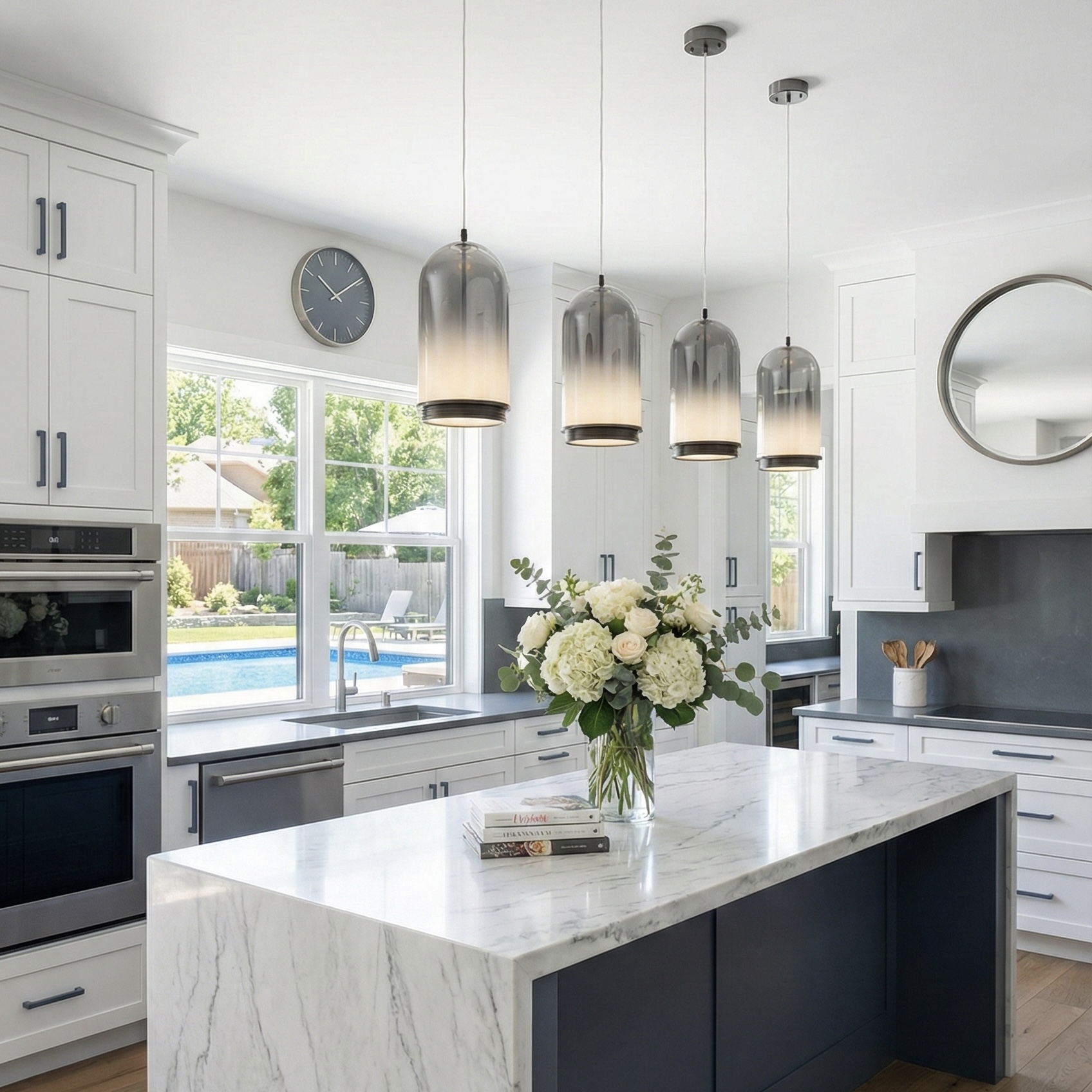
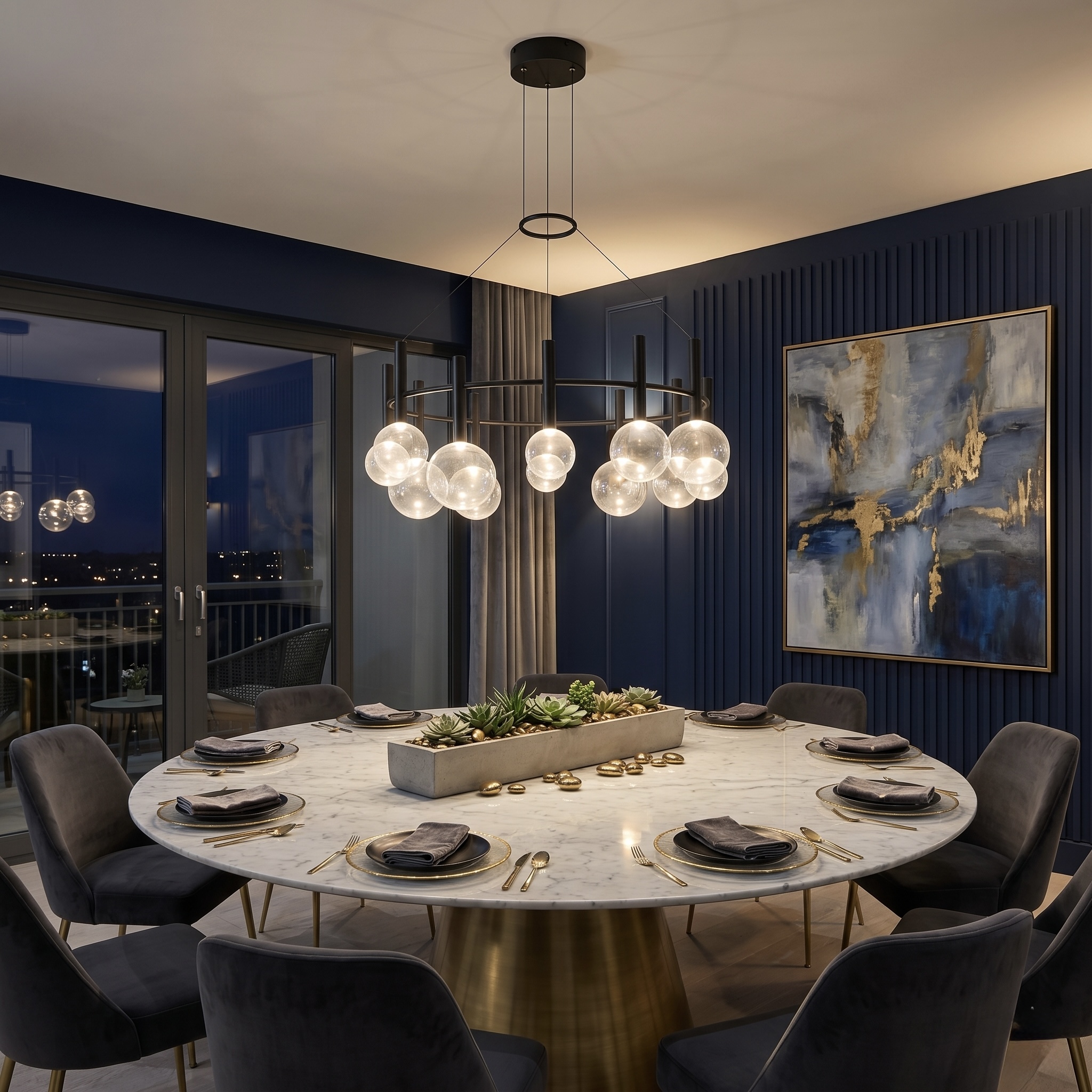
How to Choose the Right Chandelier Size for Your Dining Room
%20(1).png)
Choosing the right chandelier size is one of the most important decisions in dining room lighting. At Artcraft Lighting, we believe a chandelier should do more than look beautiful: it should fit the room, relate properly to the dining table, provide comfortable light, and create a balanced focal point.
The easiest way to choose the right chandelier is to measure three things: the dining room, the dining table, and the ceiling height. Together, these measurements help determine the ideal chandelier diameter, hanging height, and overall visual scale.
This Artcraft guide uses practical sizing rules to help you choose a chandelier that feels balanced, functional, and visually connected to your dining space. Whether your style is modern, transitional, traditional, vintage, minimalist, or statement-making, the right chandelier size helps your fixture look intentional rather than too small, too large, or poorly placed.
Quick Summary
To choose the right chandelier size for a dining room, add the room’s length and width in feet, then use that number in inches as the approximate chandelier diameter. The chandelier should usually be one-half to two-thirds the width of the dining table and should hang about 30 to 36 inches above the tabletop.
Key Takeaways
- Choose a chandelier that is about one-half to two-thirds the width of the dining table.
- Hang the bottom of the chandelier 30 to 36 inches above the dining table.
- Use more compact fixtures for 8-foot ceilings and taller fixtures for higher ceilings.
- Open, airy chandeliers can usually be slightly larger than dense or visually heavy fixtures.
- Long rectangular tables may work better with a linear chandelier or two smaller chandeliers.
- Always verify ceiling support and electrical requirements before installation.
- Use your sizing calculation as a starting point, then refine your choice by Artcraft style, finish, shape, and fixture type.
What Is Dining Room Chandelier Sizing?
Dining room chandelier sizing is the process of selecting a chandelier’s diameter, height, and hanging position based on the room’s dimensions, dining table size, ceiling height, and fixture style.
The goal is to create balanced proportions, comfortable lighting, and a focal point that complements the dining space without overwhelming it. A well-sized chandelier should look connected to the table below it, provide useful illumination, and enhance the overall design of the room.
At Artcraft Lighting, chandelier sizing is not only about measurement. It is about finding the right relationship between beauty, function, proportion, and atmosphere.
Quick Answer: What Size Chandelier Do I Need for a Dining Room?
A good starting point is this formula:
Room length in feet + room width in feet = recommended chandelier diameter in inches
For example, if your dining room is 12 feet by 14 feet, add 12 + 14 to get 26. That means a chandelier around 26 inches wide is a good starting point.
This formula should be adjusted based on your dining table size, ceiling height, fixture style, and how visually heavy the chandelier appears.
Artcraft Tip: Once you calculate your approximate chandelier diameter, use that number as a guide when browsing chandeliers. Then refine your choice by finish, silhouette, material, and whether the fixture feels visually light or visually substantial.
The Artcraft Room–Table–Ceiling Method
A practical way to size a dining room chandelier is to use the Artcraft Room–Table–Ceiling Method.
This method considers three essential measurements:
- The size of the room
- The size of the dining table
- The height of the ceiling
Using all three gives a more accurate result than relying on one measurement alone. A chandelier may technically fit the room, but if it is too wide for the table or hangs too low for the ceiling height, it will not feel right in daily use.
Step 1: Calculate Chandelier Diameter Based on Room Size
Start by measuring the length and width of your dining room in feet. Add those two numbers together. The total gives you the approximate chandelier diameter in inches.
Chandelier Diameter Examples by Room Size
| Dining Room Size | Calculation | Suggested Chandelier Diameter |
|---|---|---|
| 10 ft x 12 ft | 10 + 12 = 22 | About 22 inches |
| 12 ft x 14 ft | 12 + 14 = 26 | About 26 inches |
| 14 ft x 16 ft | 14 + 16 = 30 | About 30 inches |
| 16 ft x 18 ft | 16 + 18 = 34 | About 34 inches |
This formula provides a starting point. The final choice should also reflect the dining table size, ceiling height, and fixture style.
If you are choosing between two chandelier sizes, consider the visual weight of the design. An open-frame Artcraft chandelier may feel lighter than a dense or highly decorative chandelier of the same diameter.
Step 2: Match the Chandelier to the Dining Table
Your chandelier should normally be narrower than your dining table. A reliable guideline is to choose a chandelier that measures between one-half and two-thirds the width of the table.
Chandelier Diameter by Dining Table Width
| Dining Table Width | Suggested Chandelier Diameter |
|---|---|
| 36 inches | 18 to 24 inches |
| 42 inches | 21 to 28 inches |
| 48 inches | 24 to 32 inches |
| 54 inches | 27 to 36 inches |
| 60 inches | 30 to 40 inches |
This proportion helps the chandelier feel connected to the table without extending too far toward the edges.
Artcraft Tip: Use table width to narrow your choices, then decide whether your room calls for a round chandelier, a multi-arm chandelier, a linear chandelier, or an island-style fixture.
Step 3: Choose the Right Hanging Height
Most dining room chandeliers should hang so that the bottom of the fixture sits about 30 to 36 inches above the tabletop.
For standard 8-foot ceilings, the lower end of the range often works best: about 30 to 32 inches above the table. For ceilings 9 feet or higher, you can usually hang the chandelier slightly higher or choose a taller fixture.
A chandelier that hangs too high may feel disconnected from the table. A chandelier that hangs too low can block sight lines, create glare, or make guests feel crowded.
Chandelier Height by Ceiling Height
| Ceiling Height | Recommended Approach |
|---|---|
| 8 feet | Choose a compact fixture and hang it about 30 to 32 inches above the table. |
| 9 feet | Use a slightly taller chandelier or longer chain, usually about 32 to 34 inches above the table. |
| 10 feet or higher | Consider a taller or multi-tier chandelier, while keeping the bottom of the fixture near the 34 to 36 inch range above the table. |
| Vaulted or sloped ceiling | Use the table surface as the main reference point and install the proper slope adapter if needed. |
Many Artcraft chandeliers and pendant-style fixtures include adjustable hanging elements, which can help you fine-tune the installation height for your ceiling and table.
What Size Chandelier Works Best for a Small Dining Room?
For dining rooms under about 150 square feet, a chandelier of 25 inches wide often works well. Smaller rooms usually benefit from fixtures with open designs, lighter finishes, and less visual bulk.
Good options for small dining rooms include:
- Mini chandeliers
- Small drum pendants
- Open cage chandeliers
- Compact geometric fixtures
- Fixtures with upward or diffused light
- Close-to-ceiling or lower-profile fixtures for rooms with limited clearance
Avoid overly wide chandeliers that make the room feel crowded.
For compact dining rooms, consider browsing Artcraft chandeliers, pendants, and flushmounts that offer design presence without overwhelming the room.
What Size Chandelier Works Best for a Medium or Large Dining Room?
For dining rooms between 150 and 400 square feet, chandeliers 24 to 36 inches wide are common starting points. These rooms can usually support more decorative designs, multiple arms, larger shades, or stronger visual presence.
If the room is large, avoid choosing a chandelier that disappears visually. The fixture should be substantial enough to anchor the dining area.
Medium and large dining rooms are often well-suited to Artcraft chandeliers with more presence, including multi-light designs, statement silhouettes, mixed-material fixtures, and decorative finishes.
What Size Chandelier Works Best for a Grand Dining Room?
For dining rooms over 400 square feet, larger chandeliers of 36 inches or more may be appropriate. Grand dining rooms often have higher ceilings, which allows for taller chandeliers, multi-tier fixtures, or more dramatic designs.
Large dining rooms also benefit from layered lighting, such as wall sconces, recessed lighting, buffet lamps, or accent lighting, so the chandelier is not the only source of light.
For larger dining rooms, consider Artcraft statement chandeliers, multi-tier chandeliers, LED chandeliers, or coordinated wall sconces to create a complete lighting plan.
Round vs Rectangular Dining Tables
Round Dining Tables
For a round dining table, choose a chandelier that is about one-half to two-thirds the diameter of the table. A round, globe, lantern, or compact multi-arm chandelier often works well because the shape echoes the table.
A centered chandelier usually creates the strongest focal point over a round table.
Rectangular Dining Tables
For a rectangular table, use the table width as the main reference point. The chandelier should usually be one-half to two-thirds the width of the table.
For very long rectangular tables, a linear chandelier or two smaller chandeliers may look more balanced than one large round fixture.
When to Use a Linear Chandelier
A linear chandelier is often a good choice for long rectangular dining tables. It spreads light across the length of the table and visually follows the table shape.
Use a linear chandelier when:
- The dining table is long and narrow
- One round chandelier would leave the ends of the table underlit
- The room has a modern or transitional design
- You want a cleaner horizontal focal point
- The dining room is part of an open-concept kitchen or living area
As a general guideline, the linear chandelier should be shorter than the table and centered over it, leaving visual breathing room at both ends.
For long rectangular tables, kitchen islands, or open-concept dining spaces, explore Artcraft island chandeliers and linear fixtures. These designs can help distribute light more evenly across an extended surface.
How Style Affects Chandelier Size
Chandelier size is not only about measurement. Visual weight also matters.
An open cage chandelier may feel lighter than a solid drum chandelier of the same diameter. A crystal chandelier may appear more prominent because of its sparkle, reflections, and decorative details. A dark metal chandelier may feel heavier than a fixture in polished chrome, white, or brushed nickel.
When choosing between two sizes, consider how dense, dark, ornate, or visually heavy the fixture looks.
Artcraft Style Guide for Chandelier Sizing
| Dining Room Style | Artcraft Fixture Direction to Consider |
|---|---|
| Modern or minimalist | Clean-lined chandeliers with open silhouettes and simple geometry |
| Transitional | Warm finishes, balanced proportions, and versatile forms |
| Traditional | Decorative chandeliers with classic shapes, arms, or crystal details |
| Dramatic or formal | Larger statement chandeliers with stronger visual weight |
| Long and narrow | Linear chandeliers or island chandeliers |
| Small or casual | Compact chandeliers, pendants, or open-frame fixtures |
| Low ceiling | Flushmounts or lower-profile fixtures with less vertical drop |
How Finish Changes the Feel of a Chandelier
The finish of a chandelier affects how large or prominent it feels in the room.
Dark finishes such as black or bronze tend to create stronger contrast and visual weight. Brass, brushed brass, and gold finishes add warmth and presence. Chrome, nickel, glass, and lighter finishes may feel more reflective, airy, or contemporary.
When browsing Artcraft chandeliers, consider how the finish relates to your table, chairs, cabinet hardware, wall color, and nearby lighting fixtures.
Common Chandelier Sizing Mistakes
The most common mistake is choosing a chandelier that is too small. An undersized fixture may look like an afterthought and may not provide enough visual impact.
Other common mistakes include:
| Hanging the chandelier too high | Hanging the chandelier too low |
| Choosing a chandelier wider than the dining table | Ignoring ceiling height |
| Ignoring the visual weight of the fixture | Using one small chandelier over a very long table |
| Forgetting to confirm ceiling support and electrical requirements | Choosing a fixture based only on appearance without checking dimensions |
| Forgetting to consider how the chandelier looks from adjacent rooms in an open-concept space |
Installation and Safety Considerations
Before installing a chandelier, verify that the ceiling junction box is rated to support the fixture’s weight. Heavier chandeliers, especially large crystal or metal fixtures, may require additional bracing.
Hire a licensed electrician if you need to move the junction box, modify wiring, install a new fixture, or confirm ceiling support. Electrical work should be completed safely and in accordance with applicable local code requirements.
Before purchasing, review the fixture specifications, including width, height, overall adjustable length, wattage, bulb type, canopy size, and installation requirements.
Artcraft Design Note
The best chandelier size is not determined by style alone. A well-sized dining room chandelier should satisfy three tests: it should fit the room, relate proportionally to the table, and hang at a height that provides comfortable light without interrupting conversation.
The strongest results come from combining formulas with judgment about ceiling height, fixture shape, finish, material, and visual weight. Use the Artcraft Room–Table–Ceiling Method as your starting point, then choose a fixture that supports both the function and atmosphere of your dining room.
Find the Right Artcraft Chandelier for Your Dining Room
Once you know your approximate chandelier diameter and hanging height, you can use those measurements to narrow your fixture options.
Start with the size range that fits your room and table. Then refine your choice by:
- Fixture shape
- Finish
- Number of lights
- Overall height
- Adjustable hanging length
- Visual weight
- Design style
- LED or non-LED lighting preference
- Whether the table is round, square, rectangular, or extra long
For a traditional centered focal point, browse Artcraft chandeliers. For long rectangular tables or kitchen-dining spaces, consider Artcraft island chandeliers or linear fixtures. For smaller rooms or lower ceilings, explore compact chandeliers, pendants, or flushmounts.
Summary: Best Chandelier Size Rules
Use these rules as a starting point:
- Add room length and width in feet to estimate chandelier diameter in inches.
- Choose a chandelier one-half to two-thirds the width of the dining table.
- Hang the bottom of the chandelier 30 to 36 inches above the tabletop.
- Adjust for ceiling height, fixture shape, finish, and visual weight.
- Use a linear chandelier or multiple fixtures for long rectangular tables.
- Confirm electrical support before installation.
- Choose a fixture that balances Artcraft’s design principles of beauty, function, proportion, and lasting atmosphere.
Frequently Asked Questions
What size chandelier do I need for a 10x12 dining room?
For a 10-foot by 12-foot dining room, add 10 + 12 to get 22. A chandelier around 22 inches wide is a good starting point. Adjust slightly based on your table width, ceiling height, and fixture style.
How low should a chandelier hang over a dining table?
A dining room chandelier should usually hang 30 to 36 inches above the tabletop. For an 8-foot ceiling, aim for about 30 to 32 inches. For higher ceilings, the fixture can often hang slightly higher.
Should a chandelier be wider than the dining table?
No. A chandelier should usually be narrower than the dining table. A good guideline is to choose a chandelier that is one-half to two-thirds the width of the table.
What size chandelier works best for an 8-foot ceiling?
For an 8-foot ceiling, choose a chandelier with a compact vertical profile. The fixture should usually hang about 30 to 32 inches above the dining table, leaving enough clearance for sight lines and comfort.
Can a chandelier be too big for a dining room?
Yes. A chandelier that is too large can make the room feel crowded, overwhelm the table, and create uncomfortable visual weight. Use the room-size formula and table-width guideline together to avoid oversizing.
What size chandelier should I use over a 60-inch dining table?
For a 60-inch wide dining table, a chandelier between 30 and 40 inches wide is a reasonable starting range. Choose the smaller end for visually heavy fixtures and the larger end for open, airy designs.
Is a round or rectangular chandelier better over a dining table?
A round chandelier often works well over a round or square table. A rectangular or linear chandelier often works better over a long rectangular table because it distributes light more evenly along the table length.
How do I choose a chandelier for an open-concept dining room?
In an open-concept space, size the chandelier based on the dining area rather than the entire room. The chandelier should define the dining zone while coordinating with nearby kitchen or living room fixtures.
Do I need two chandeliers over a long dining table?
For very long dining tables, two smaller chandeliers or one linear chandelier may provide better balance and light distribution than one central fixture. This is especially useful for tables longer than 8 feet.
Do I need an electrician to install a chandelier?
Use a licensed electrician if you are installing a new fixture, moving a junction box, modifying wiring, or installing a heavy chandelier that requires additional support. Simple chain adjustments may not require professional help, but electrical work should be handled safely.
How do I choose an Artcraft chandelier after measuring my room?
Start with your recommended diameter range, then browse Artcraft chandeliers by size, finish, shape, and style. For long rectangular dining tables, consider an Artcraft island chandelier or linear fixture. For smaller rooms, consider compact chandeliers, pendants, or lower-profile fixtures.